
Camera vs Behavior-Based Drowsiness Detection Systems
Compare camera-based facial tracking against behavior-based vehicle telemetry to see how hybrid AI models prevent commercial fleet accidents.
.png)
Camera vs Behavior-Based Drowsiness Detection: What Each Catches and What Each Misses
Camera-based drowsiness detection analyzes facial landmarks and eye closure rates to identify physical fatigue, while driving-behavior-based detection monitors CAN bus telemetry like steering entropy to spot operational decline. The most reliable approach for enterprise fleets combines both into a hybrid AI model, ensuring that physical microsleeps and cognitive distraction are caught before a mechanical failure occurs.
What Is the Core Evaluation for Fleet Fatigue Monitoring?
Hybrid AI fatigue platforms synthesize camera-based facial tracking with behavior-based CAN bus telemetry, using the two data streams to cover each other's blind spots. The result is an architecture that prevents accidents by catching physiological decline before it ever shows up as a mechanical failure.
Safety directors evaluating fatigue monitoring must determine whether to track the driver's physical state or the vehicle's operational output. The core evaluation centers on identifying which data stream provides the earliest possible warning of impairment. Fleets that choose the wrong primary metric risk deploying systems that document accidents rather than preventing them.
Why Do Single-Source Detection Methods Fall Short?
Single-sensor fatigue systems process either visual or mechanical data in isolation, and that fragmented view misses critical context during edge-case events. When a fleet relies on a single telemetry stream, accidents can slip through the gaps between what each sensor is able to detect.
Behavior-Based Systems monitor the vehicle's onboard diagnostics port to track steering wheel movements and braking patterns. This identifies erratic driving but misses the critical 1.5 seconds of a microsleep where the vehicle remains perfectly straight but the driver is unconscious. Conversely, purely Camera-Based Systems struggle when environmental factors degrade visual input, leading to missed alerts if the hardware is not built for low-light conditions.
What Criteria Separate Effective Fatigue Detection Frameworks?
Hybrid AI Models combine camera and driving data for fatigue detection by cross-referencing facial telemetry with steering entropy in real time, validating what the camera sees against how the vehicle is actually being driven. Because the two signals confirm each other, interventions only trigger when a genuine risk threshold is breached.
Effective fatigue detection frameworks require multi-modal data validation to eliminate false positives. If a camera detects heavy eyelids but the steering input remains sharp, the system evaluates the combined risk score. If both signals degrade simultaneously, the edge node triggers an immediate in-cab intervention. This cross-validation separates precise safety tools from noisy alarm systems.
To see how this plays out on the road, consider a regional logistics hub operating a fleet of 80 long-haul trucks on overnight routes. The safety team initially deployed a purely behavior-based detection system, relying on lane departure warnings and hard-braking telemetry to flag exhausted drivers, on the assumption that tired drivers drift or brake erratically before a critical event.
That assumption broke down during a 3:00 AM run. A driver experienced a three-second microsleep on a straight, empty stretch of highway, and because the vehicle never drifted and the steering wheel barely moved, the behavior-based system registered zero anomalies. On paper, the truck's operational metrics were flawless. The driver woke only when the tires hit the rumble strip, narrowly avoiding a catastrophic rollover. The system had completely missed the physiological reality of highway hypnosis.
After the team transitioned to a hybrid evaluation framework, the same situation played out very differently. The next time a driver's blink rate slowed and head posture dropped on that route, the inward-facing camera registered the physical decline, and before the vehicle ever drifted, the edge processor correlated the facial data with the lack of steering input and triggered a 90-decibel in-cab alert. The system caught the exhaustion at the biological level before it translated to the mechanical level, protecting both the vehicle and the driver.
How Do Camera and Behavior Systems Compare in Practice?
Camera-Based Systems analyze driver physiology, whereas Behavior-Based Systems analyze vehicle kinematics, and each delivers a distinct stream of telemetry to fleet management dashboards. Comparing the two side by side reveals where each detection method is strongest.
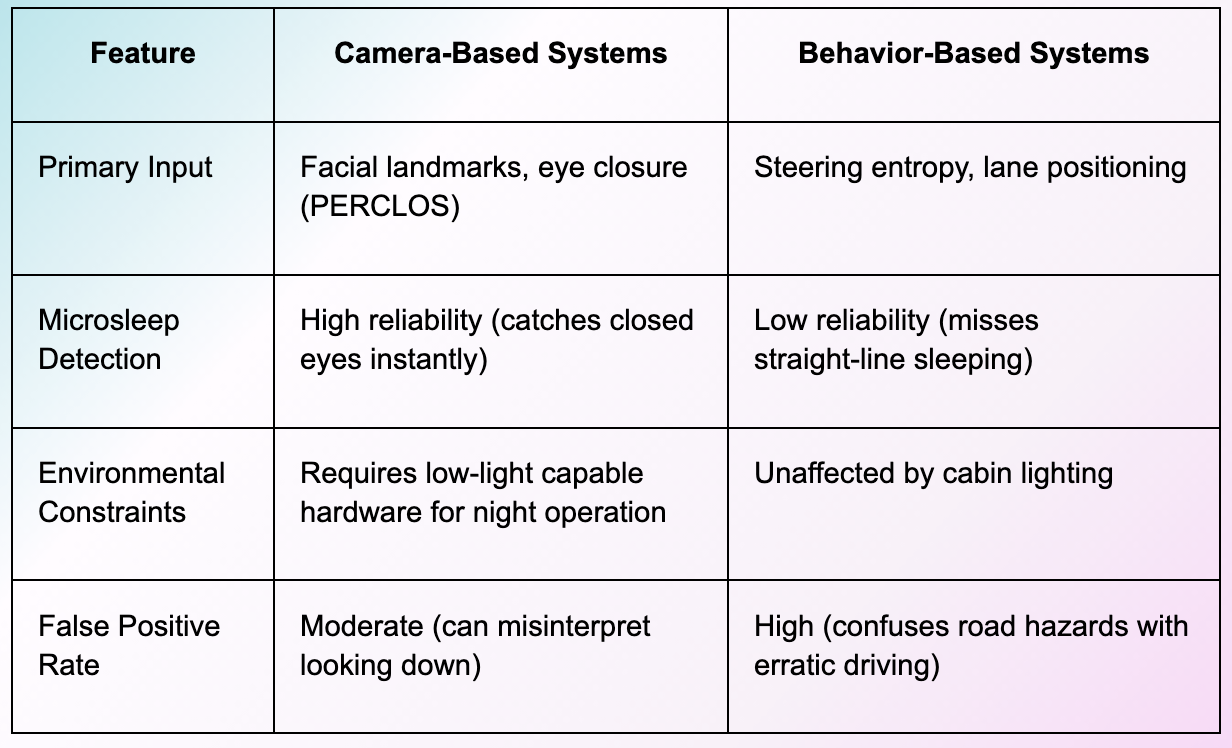
What Are the Limitations of Each Monitoring Approach?
Every monitoring approach has environmental and technical limits, and mapping them in advance prevents fleets from deploying sensors in environments where they underperform. Understanding these constraints is what keeps monitoring continuous across changing lighting and road conditions.
Considerations before implementation:
- Camera-Based Systems struggle to differentiate tired from distracted driving if the driver wears heavily mirrored or reflective glasses that fully conceal the eyes, forcing the system to rely on head and posture cues alone.
- Behavior-Based Systems generate excessive false positives on winding rural roads where constant steering corrections are required.
- Poor lighting affects camera-based fatigue alerts unless the hardware and AI are designed for reliable low-light performance.
- Bandwidth consumption increases by up to 40% when transmitting continuous video telemetry compared to lightweight CAN bus data.
What Operational Authority Thresholds Govern System Selection?
Operational authority thresholds define the exact biological and mechanical metrics required before an in-cab alert fires. Enforcing them strictly keeps false positives from overwhelming the driver, which preserves trust in the system while still ensuring that critical interventions happen.
- Visual Confidence Score < 60%: High Risk. If sunglasses or poor lighting obscure the eyes, the system must automatically failover to behavior-based tracking.
- Steering Entropy Deviation > 15%: Moderate Risk. Triggers an elevated monitoring state but requires visual confirmation before sounding an in-cab alarm.
- PERCLOS (Percentage of Eye Closure) > 80% for 1.5 seconds: Critical Alert. Bypasses all behavioral checks and triggers immediate intervention regardless of vehicle stability.
To view exactly how these thresholds operate in a live fleet environment, safety directors should request a multi-modal telemetry demonstration.
How Should Fleets Proceed With Implementation?
Multi-modal fatigue detection platforms synchronize edge-computing hardware with cloud-based safety dashboards, processing video and CAN bus data locally to minimize latency. That architecture is what allows life-saving alerts to sound within milliseconds of a detected event.
Integrating Hybrid AI Models starts with aligning hardware capabilities to your fleet's safety objectives. Comparing the telemetry each system produces allows safety directors to build a precise incident prevention framework. Start by evaluating where your current fleet telemetry leaves gaps, then select the safety hardware that closes them.
Quick Answers for Fleet Managers
What specific driver behaviors trigger a vehicle-based drowsiness alert?
Behavior-Based Systems trigger alerts when they detect sudden, jerky steering corrections, inconsistent accelerator pressure, or repeated drifting across lane markings without turn signal activation. The system calculates these deviations against the vehicle's normal baseline.
Which is more reliable for detecting microsleeps: camera or behavior analysis?
Camera analysis is significantly more reliable for detecting microsleeps. It identifies the physical eye closure instantly, whereas behavior analysis entirely misses the event if the vehicle happens to be traveling on a straight road without drifting.
How do sunglasses or poor lighting affect camera-based fatigue alerts?
Basic cameras can lose track of eye movement behind dark lenses or in dim cabins. Enterprise-grade inward-facing cameras address this with high-sensitivity, low-light sensors and AI that falls back on secondary cues such as head position, nodding patterns, and blink cadence when the eyes are obscured.
Can camera-based systems distinguish between tired and distracted driving?
Yes. Camera-Based Systems classify tired driving by measuring blink duration and head nodding. They classify distracted driving by tracking the driver's gaze vector when it remains locked away from the windshield for more than two seconds.
What are the technical prerequisites for integrating hybrid AI fatigue models?
Implementing Hybrid AI Models requires installing an edge-computing dashcam connected directly to the vehicle's OBD-II or J1939 diagnostic port. This physical connection synchronizes the video feed with the mechanical CAN bus telemetry.
What is the typical ROI timeframe for a multi-modal fatigue detection system?
The ROI timeline varies based on fleet size, baseline incident rates, and how the system is rolled out. Many fleets begin to see measurable value within the first year as collision-related repair costs fall and verifiable safety compliance helps lower commercial insurance premiums.
